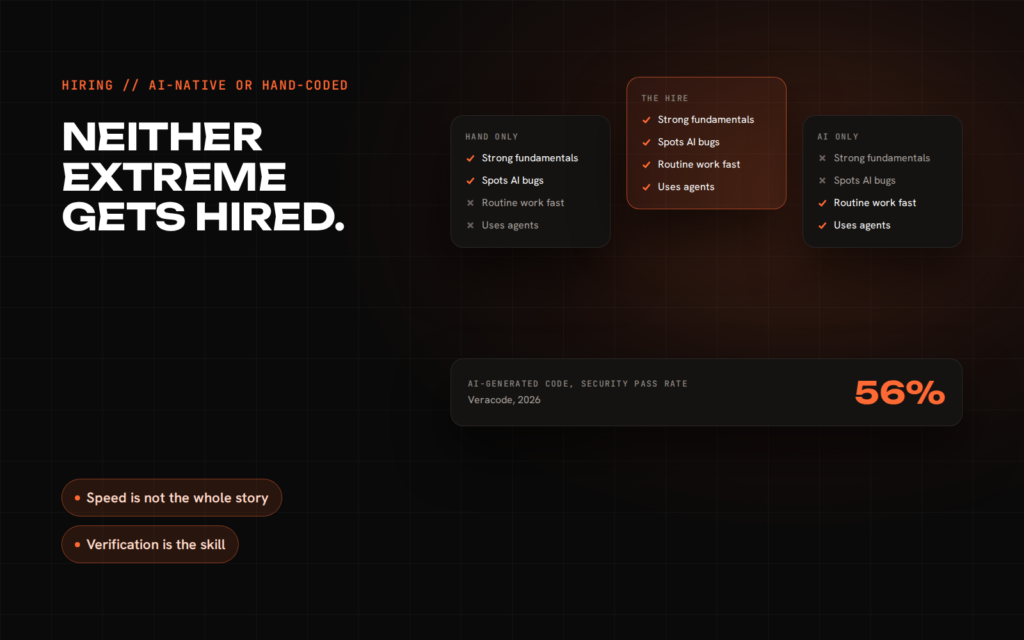
Some developers still write every line themselves and refuse AI tools on principle. Others proudly say they have not written a function by hand in a year. If you are hiring in 2027 you will interview both, and it is fair to wonder which one to bet on. My answer: neither extreme is the hire you want.
The case for AI-native developers
AI coding tools are no longer an experiment. In Google’s 2025 DORA report, 90% of software professionals used AI at work, and more than 80% said it made them more productive. Stack Overflow’s 2026 survey found that two thirds of developers who use AI now use coding agents, not just autocomplete. Teams that refuse these tools entirely will be slower at a lot of everyday work: boilerplate, tests, migrations, documentation, and exploring an unfamiliar codebase.
A developer who will not use them at all is, in most teams, choosing to be slower at the routine part of the job. That is hard to justify on a salary.
The case for hand-written skill
The evidence on quality and speed is far less flattering than the marketing.
- Perceived speed is not real speed. In METR’s 2025 randomised trial, experienced open-source developers were 19% slower with AI tools on their own repositories, while believing they had been about 20% faster. METR’s 2026 follow-up says the effect is now hard to measure and calls its newer numbers only weak evidence, but the gap between feeling fast and being fast is the lesson.
- Security has not caught up. Veracode’s testing of AI-generated code found that 45% of samples introduced vulnerabilities in 2025, and its 2026 report put the average security pass rate at 56%, essentially unchanged. In their words: syntax is solved, security is not.
- Maintainability suffers. GitClear’s 2026 analysis of 623 million code changes found duplicated code blocks up 81% since 2023 and refactoring down to under 4% of changed lines.
- AI amplifies what is already there. DORA describes AI as an amplifier: it raised delivery throughput but was also linked to lower delivery stability.
All of this points the same way. AI produces code faster than people can verify it. The bottleneck has moved to judgement, and judgement comes from having written, read and debugged a lot of code yourself.
So who do you hire?
The developer you want in 2027 uses AI tools every day and could do the job without them. In practice, that looks like this:
- They can explain every line of a pull request, including the parts the AI wrote.
- They write or demand tests for AI-generated code before trusting it.
- They know which tasks to hand to an agent and which to write themselves, usually anything involving security, money, data integrity or tricky business logic.
- They notice when the AI is confidently wrong, because they know what right looks like.
- They keep code simple enough for the next person, human or agent, to change safely.
How to tell in an interview
Give candidates a small piece of AI-generated code with a subtle bug and a security problem in it, and ask them to review it. The hand-only developer will find the problems but may be slow on the rest of the task. The AI-only developer will often approve it. The developer you want finds both problems quickly and explains how they would have prompted or tested to avoid them.
Then ask one question without tools: walk me through how you would design this feature. If the answer is “I would ask the AI”, you have your answer.
What about the hand-coder who is genuinely excellent?
If a candidate is exceptional at fundamentals but does not use AI, I would not rule them out. I would ask why. “I tried it and it slowed me down on this kind of work” is a thoughtful answer and often true for experts in a codebase they know deeply, as the METR study suggests. “I refuse to learn it” is a different answer, and in a small team it is a problem. The first person can learn the tools in a few weeks. The second will not.
The opposite risk is bigger, though. A developer who cannot work without AI cannot tell when it is wrong, and that cost shows up later, in production, where it is most expensive.
This is the second half of my guide to hiring developers in 2027. If you want help assessing a candidate or a team’s AI practices, book a free 30-minute call.
Sources: METR: early-2025 AI developer study · METR: 2026 uplift update · Google DORA 2025 report · Veracode 2026 GenAI Code Security Report · GitClear: the maintainability gap (2026) · Stack Overflow Developer Survey 2026