Hiring a developer used to be a fairly stable process: a CV screen, a coding test, a technical interview, a culture chat. AI coding tools broke the middle of that. Algorithm puzzles are now trivial for any assistant, take-home tests no longer tell you who wrote the code, and the job itself has shifted from typing code to directing, reviewing and verifying it.
After 13 years in outsourcing, on both the hiring and the delivery side, here is how I would hire developers going into 2027.
What the market looks like now
- AI use is the norm. In Stack Overflow’s 2025 survey, 84% of developers used or planned to use AI tools, and about half of professional developers used them daily. Trust is another matter: about 46% said they distrust the accuracy of AI output.
- Demand has tilted to seniors. Indeed’s Hiring Lab found that in the first quarter of 2026, 69.3% of US software development job postings were senior-level and only 4.5% were entry-level.
- Juniors are being squeezed. Stanford’s Digital Economy Lab found employment of software developers aged 22 to 25 down nearly 20% from its late-2022 peak by September 2025, while experienced developers held steady.
- Freelance rates are flat. In the DACH region, freelancermap’s 2026 survey put the average IT freelancer rate at €103 an hour, the first decline since the survey began, with a median of €90 for software and web development.
For a hiring manager, that means good senior people are still in demand and not cheap, while capable juniors are easier to find than they have been in years.
What to test for now
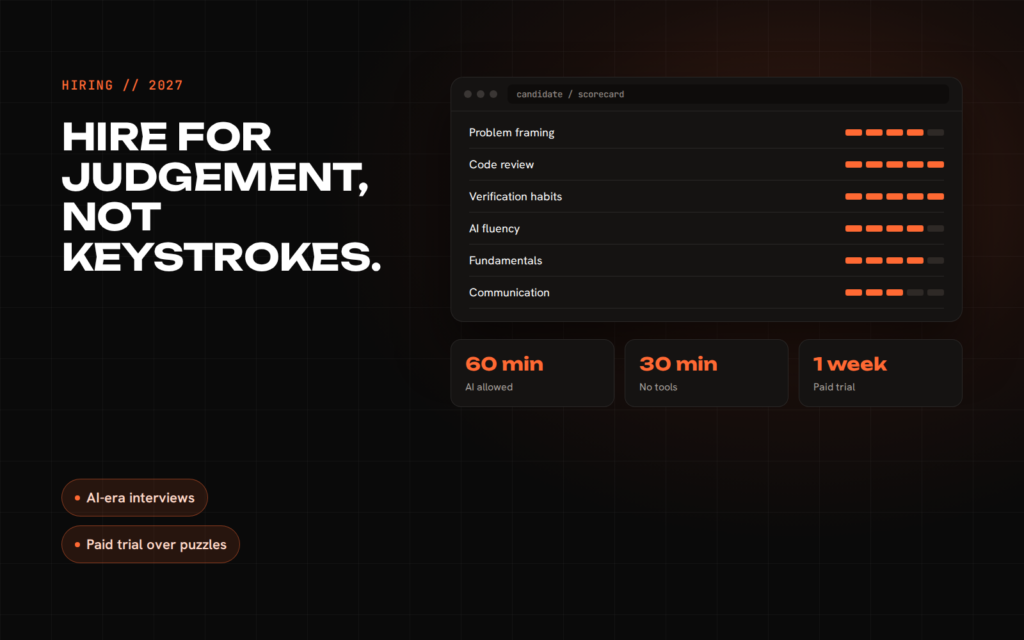
The skills that separate good developers have moved. Writing a sorting function from memory matters less. These matter more:
- Problem framing. Can they turn a vague business request into a clear, small piece of work?
- Reading and reviewing code. Most of the job is now reviewing code, often code they did not write. Can they spot the bug, the security hole, the duplicated logic?
- Verification habits. Do they test what the AI produced, or paste it in and move on?
- Using AI well. Do they give tools good context, break work into steps and know when to stop prompting and think?
- Fundamentals. Data modelling, security basics and how the web actually works. Without these, they cannot tell when the AI is wrong.
- Communication. With AI doing more of the typing, explaining trade-offs to non-technical people is a bigger share of the value.
How interviews are changing
Companies have split into two camps. Canva replaced its computer science fundamentals screen with an AI-assisted coding interview in 2025, expecting candidates to use tools like Copilot, Cursor or Claude and assessing how they judge and fix the output. Meta has piloted similar AI-enabled interviews. On the other side, Google brought back at least one in-person round because of AI-assisted cheating, and Anthropic asks candidates not to use AI in live interviews unless told otherwise.
Both camps are measuring something real, so the process I recommend uses both: one session with AI tools allowed, and one short conversation without them.
A process that works for small teams
- Write down the outcome, not a job description. “In six months, this person owns our HubSpot integrations and ships the AI lead routing” beats a list of 15 technologies.
- Screen on real work. Ask for one or two things they built and what they would do differently. Portfolios and code they can walk through beat CVs.
- Run a 60-minute AI-allowed session. Give them a small, realistic task in a codebase with a planted bug and some AI-generated code to review. Watch how they work, not just whether they finish.
- Run a 30-minute conversation without tools. Talk through a design decision, a production incident they handled, or how they would structure a feature. This shows whether the understanding is theirs.
- Pay for a short trial. For contract roles especially, a paid week on a real, contained task tells you more than any interview.
- Check references on how they work, not just what they did. Ask how they handled being wrong, and how they reviewed other people’s code.
Contract, full-time or a partner team?
- Full-time when the work is core to your product and continuous, and you can give someone ownership.
- Contract when the need is defined and time-boxed, or while you figure out what the role really is. Stack Overflow’s 2026 survey found self-employed developers rising to around one in ten, so the pool is growing.
- A partner team when you need several skills at once, such as design, front end and integrations, and do not want to manage each person. Make sure someone on your side, or an advisor you trust, can review their work.
Do not skip juniors entirely
The data shows companies hiring fewer juniors. That is understandable in the short term and expensive in the long term, because today’s juniors are the seniors you will struggle to afford in five years. A junior who uses AI well and is paired with a strong reviewer can be productive quickly. The key word is reviewer: juniors without review, using AI, produce code that looks finished and is not.
The second half of this question, whether to hire developers who still write code entirely by hand, deserves its own post, and it is coming next.
If you are hiring for a technical role and want a second opinion on the brief, the process or a candidate’s work, that is part of what I do. Book a free 30-minute call. I also wrote about why prompting without systems design leads to a plateau.
Sources: Stack Overflow Developer Survey 2025: AI · Indeed Hiring Lab: tilting toward seniority · Stanford Digital Economy Lab: Canaries in the Coal Mine · freelancermap: IT freelancer rates 2026 · Canva: yes, you can use AI in our interviews · Anthropic: guidance on candidates’ AI usage · Stack Overflow Developer Survey 2026